
Software and AI automation FAQ: your questions answered
Short, direct answers about custom software, inventory and billing systems, WhatsApp, voice and SMS automation, lead automation and AI agents.
Custom software, ERP, inventory and billing
Custom software development FAQ
Custom software development is designing and building software specifically for one business, so the screens, rules and reports match how that business works. It differs from off-the-shelf software, which is built for many businesses and configured rather than designed.
Cost depends on the number of modules, users, integrations and reports. We give a fixed scope and quote after a discovery call, so you know what is included before you commit. A small single-purpose tool costs far less than a full ERP.
A focused tool can be ready in weeks, while a multi-module system is delivered in stages over a few months. We agree a stage-by-stage plan during scoping so your team can start using the first modules early.
You do. We hand over the code, hosting access and documentation, and your data stays in your own database.
Yes, where the other tool offers an export or an API. We scope each integration during discovery and tell you what is possible before you commit.
Our team is based in Kompally, Hyderabad, and we meet local clients in person. We also build software for businesses elsewhere and work with them over video calls.
ERP, CRM and billing software FAQ
CRM manages customers, leads and sales follow-up. ERP manages internal operations such as purchase, stock, production and accounts. Many businesses need both, and connecting them avoids duplicate data entry.
Yes. We build GST invoice formats, tax calculations, credit and debit notes and customer ledgers, and can export data in the formats your accountant needs.
It depends on how unusual your process is. If standard software fits, use it. If you keep working around it, a custom build usually pays back through less manual work and fewer errors.
Yes. We build responsive web software that works on phones and tablets, and can add a dedicated mobile app for tasks such as scanning or field sales.
Yes. We import customers, items, opening stock and balances from Excel or your current software and check them with you before go-live.
Inventory management software FAQ
Inventory management software records what a business holds, receives, uses and sells, so the stock position is always known. It replaces manual registers and spreadsheets with one live record and alerts when items run low.
Custom software models your own items, production stages and reports. Ready-made tools suit standard stock, but manufacturers with specifications, jobs and multiple stages often need something built to match.
Yes. We have built inventory software for corrugated packaging companies, covering raw material, production stages, finished boxes and dispatch.
Yes. We can add barcode or QR labels and scanning so stock counts and movements are faster and more accurate.
Yes. Stock movements can drive invoices, purchase bills and ledgers, or export clean data to your accountant.
Jewellery billing software FAQ
Jewellery billing software creates bills based on weight, purity, daily metal rate, making charges and tax, and keeps stock tracked tag by tag. It is designed for the way jewellery is priced and sold.
Yes. We build custom jewellery software around your own billing rules, categories, schemes and reports instead of fitting you into a fixed template.
Yes. Making charges, wastage, stone value and discounts are configured per item or category and calculated automatically on the bill.
Yes. Stock, billing and reports can be shared or separated across branches, with access limited by role.
Yes. We can send bills, reminders and scheme updates through WhatsApp or SMS after the customer has agreed to receive messages.
Coaching centre management software FAQ
Coaching centre management software is a system that manages enquiries, admissions, batches, attendance, fees and test results for a coaching or tuition centre in one place, with reports for the owner.
Ready-made apps follow a fixed model. Custom software follows your batches, fee plans, branches and reports, so staff do not need workarounds and you only pay for the modules you need.
Yes. Branches, batches, faculty and rooms are set up separately, and each user sees only what their role needs while the owner sees everything together.
Yes. Updates can be sent through WhatsApp or SMS to parents who have given consent, and fee reminders can be scheduled before the due date.
Access is limited by role, parent consent is recorded for minors and data is kept only as long as it is needed. Details are in our privacy policy.
Cost depends on modules, branches and integrations. We give a written scope and quotation after a discovery call. You can also buy it for lifetime use and receive the printers, supplies, setup and training under our lifetime offer.
Clothing and boutique software FAQ
Boutique management software handles billing, size and colour stock, tag printing, customer records, alterations and reports for a clothing or boutique store in one system.
Yes. Each style is stored with its sizes and colours, so billing, returns and purchases update the right variant and you see what is left in each size.
Yes. Labels are printed from the software on a thermal tag printer, and the barcode is scanned at the counter. Our lifetime offer includes the printer and a year of tags.
Yes. You can record measurements, the garment, the tailor and the promised delivery date, and send a reminder when the order is ready.
Yes. Stock, billing and reports can be shared or separated across branches, with transfers between them and access limited by role.
Cost depends on branches, users and modules. We give a written scope and quotation after a discovery call, and you can buy it for lifetime use with the printers, supplies, setup and training included.
AI, WhatsApp, voice, SMS and lead automation
AI automation agency FAQ
An AI automation agency designs and builds systems that handle repetitive business tasks automatically, such as answering customers, following up leads, sending invoices and syncing data, and connects them to the tools a business already uses.
Start with work that is frequent, rule-based and time-sensitive, such as replying to new enquiries and sending payment reminders. These bring quick returns and are easy to test.
It removes repetitive tasks so staff can focus on conversations and decisions. We design handoffs so a person takes over whenever a case needs judgement.
We use access controls, limit what each automation can read and write, and keep logs. We also help you follow opt-in and consent rules for messages.
Yes. Because we build both, automation can read and update your software directly instead of relying on exports.
WhatsApp automation FAQ
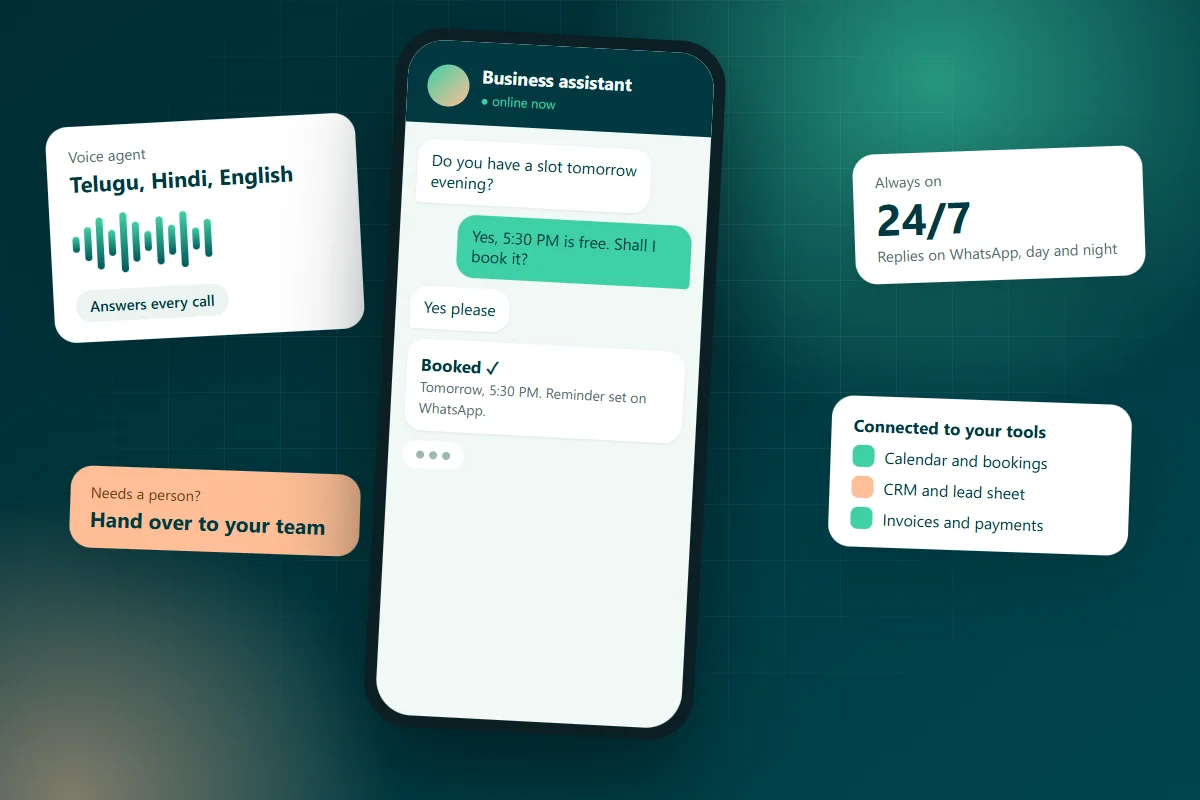
WhatsApp automation is using software to send and respond to WhatsApp messages automatically: instant replies, lead capture, bookings, reminders and invoices. It runs on the WhatsApp Business Platform and can hand chats to a person when needed.
Yes, when done through the official WhatsApp Business Platform with customer opt-in and approved message templates. Unofficial tools that send bulk messages from personal numbers risk the number being banned.
In most cases yes, by registering the number on the WhatsApp Business Platform. We explain what changes, such as how the number is used on the phone app, before you decide.
Yes. We connect chats to your CRM, Google Sheets, billing or custom software so enquiries, orders and payments update automatically.
Cost has three parts: our build and setup, your WhatsApp platform and message charges, and optional monthly improvement. We estimate these after understanding your volume and flows.
Yes. Flows can be written in the languages your customers use, and multilingual understanding can be added where messages arrive in several languages.
AI voice agents FAQ
An AI voice agent is software that holds spoken conversations over the phone. It understands what the caller says, answers from approved information, takes actions such as booking, and records the result.
We recommend the agent introduces itself clearly as an assistant. Being open builds trust and meets good practice for automated calls.
Language support depends on the speech technology used and is confirmed through testing on real calls before launch. We tell you plainly what works well and what does not.
It transfers the call to a person, or records the request and schedules a callback, with a summary so the caller does not have to repeat themselves.
Yes, for follow-ups, reminders and surveys to people who have agreed to be contacted, within telecom rules for automated calls.
SMS automation FAQ
SMS automation is sending text messages automatically based on triggers such as an order, a payment or a date, using templates and your customer data, without anyone sending each message by hand.
DLT is the registration system Indian telecom operators use for commercial SMS. Businesses register their entity, sender header and message templates before sending, and messages that do not match are blocked.
Yes. We connect through the software's API or export, and for software we build ourselves the integration is built in.
Neither is always better. SMS is universal and ideal for OTPs and alerts. WhatsApp supports rich conversations. Many businesses use both.
Yes. We handle opt-out requests and keep logs so you respect customer preferences.
Invoice automation FAQ
Invoice automation is creating, sending and following up invoices through software rather than manual steps, including taxes, payment links, reminders and payment recording.
Yes. We build GST-ready invoice formats with tax calculations and credit notes, and can export data for your accountant or accounting software.
Yes. We add payment links so customers pay by UPI, card or net banking, and the payment is recorded against the invoice.
Where the tool allows import or has an API, yes. We confirm the exact method during scoping.
You control the wording and schedule. We write reminders that are firm but courteous and stop them as soon as payment arrives.
Lead generation FAQ
Lead generation services use advertising, search optimization, landing pages and follow-up systems to bring potential customers to a business and collect their contact details.
Lead generation brings new enquiries in. Lead automation handles what happens after they arrive: capture, reply, assignment and follow-up. Strong results need both.
Paid campaigns can bring enquiries within days of launch. SEO and Maps visibility build over weeks and months.
We track which source produced each enquiry and how many became conversations, quotations and sales, using CRM stages that you control.
No. Results depend on market, offer and budget. We commit to specific work, tracking and weekly improvement, and report real numbers.
Lead automation FAQ
Lead automation uses software to capture enquiries, respond instantly, assign them to the right person and follow up on a schedule, so no lead is forgotten and response time stays short.
You need somewhere to hold leads and their stages. We can use your existing CRM or sheet, or build a simple CRM tailored to your sales process.
Yes. WhatsApp is often the best channel for the first reply and follow-up in India, provided the customer has agreed to be contacted.
We write messages in your tone, keep them short and hand the conversation to a person quickly. Automation handles the first reply and the reminders, not the relationship.
You see response time, number of follow-ups sent, conversion by stage and source performance in a simple dashboard.
Custom AI agents FAQ
An AI agent for business is software that understands requests in natural language and performs tasks across your tools, such as answering customers, booking appointments, preparing invoices and updating records, within limits you set.
Traditional automation follows fixed rules. An agent can interpret open-ended requests and choose among actions. We combine both: rules for what must be exact, an agent for what needs understanding.
It is safe when access is limited and monitored. We give each agent only the permissions it needs, require approval for sensitive actions and keep full logs.
Agents can misunderstand requests or give a wrong answer. That is why we test on real cases, restrict their scope, show their sources where possible and hand over to a person when confidence is low.
Frequent, well-defined tasks with clear rules and a measurable outcome: answering common questions, booking appointments, qualifying leads, chasing payments and preparing reports.
Business process automation FAQ
Business process automation uses software to carry out repeatable business steps without manual effort, such as data entry, approvals, notifications and reports.
Processes with clear rules, regular volume and a digital trail: enquiry handling, invoicing, reminders, stock alerts and reporting.
Not always. Many automations connect tools you already use. If those tools are limiting, we can build software that fits the process.
We document the current steps, automate one stage at a time and test with real cases before switching over, keeping a manual fallback.
It depends on volume and the time saved per task. We estimate it with you before building so you can judge the return.
Have a question we did not answer?
Ask us directly. We reply with a clear answer and, if it helps, a suggested plan.
We also build custom software and AI automation for your business.